A year after starting on my own, in 1980, I was trying out ideas on the foods I was handling in order to boost revenue. For example, salmon roe and shrimp were bulk sellers. Back then, I found that I can boost sales by purchasing in large packs and then repackaging into smaller ones. I bought shrimp in large packs at a low price, because they were damaged during shipping. Then, I made sure to repackage the shrimp that were good quality into smaller packs, and turned the damaged ones into paste for use in ready-made dishes.
I also started handling pickles and fried chicken used in lunch boxes by procuring them from abroad. This all happened because of a story I heard during a business trip to Bangkok. I heard that a custom-made silk suit could be made there at a cost of 5000 JPY. In Japan, the same suit would cost several tens of thousands of yen. Consequently, I created a flow, where the Japanese measurement data was sent to Bangkok by fax, the silk suit was made there, and it was imported to Japan afterwards. I took the same approach for pickles and fried chicken.
I farmed and processed the pickles in China, and then imported them. At the time, a kilograms of cucumber was worth 300 JPY in Japan, while it was 100 JPY in China. Daikon radish and egg plants were also inexpensive, so I developed an on-site environment from farming to processing. Fried chicken was handled in Thailand, where the farming and processing was also done on-site. I even dealt with the development of broiler chicken. Only thigh meat was used for fried chicken back then, but when we found that even inexpensive breast meat was delicious, we incorporated this too. Nowadays it is common for food production to be done abroad, but back then, I did not hear of anyone else that would be doing it besides us.
<<Start of tuna imports. The beginning of an adventure across the world in search of tuna>>
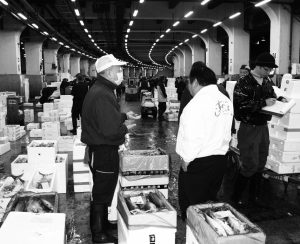
When I visited New York in 1982, I saw something that surprised me at a market near the mouth of the Hudson River. The most premium portions of a blue-fin tuna, the fatty and lean red tuna, and the cheeks were all sold at the same price, at about 1200 JPY, which was unthinkable in Japan. At that time, tuna was not as popular overseas, but even then I was astonished at such a difference in price, all because of a difference in dietary culture. I only purchased the fatty tuna portion and went back home that time.
Later I learned that tuna could be caught just offshore Northern Main on the US side of the Atlantic Ocean. I immediately charted a boat and went fishing for tuna there. I then sent several blue-fin tuna that I caught back to Japan, but I also noticed other things as well. I noticed that eel and sea urchin were just lurking about in the sea and the rivers without being caught, probably because they are not included in the dietary habits of the locals. After acquiring the license, I caught these too and imported them to Japan. This also turned out to be fantastic business. Due to such experience, I learned when and where tuna was caught around the world.
One day while I was vacationing in Monte Carlo in Monaco, I was approached by a manager of the travel agency’s branch from Madrid inquiring if I wanted to purchase some tuna. I was interested, but had no clue where and how I could make the purchase. I was simply told to go to the coastal town of Alicante in Spain. I immediately changed my travel itinerary. After renting a car and driving along the Mediterranean Coast, I arrived to the market in Alicante. I do not remember how many tens of tons it was, but I do remember that I purchased a lot. I received good feedback from the market in Japan, even from my friend’s sushi shop. I set up a trade route, and this I believe, was the start of the now popular Atlantic blue-fin tuna caught in the Mediterranean market in Japan.
There was a fish store in Monzen-Nakacho in Tokyo near a karaoke bar that I operated that closed due to land sharks. I rented this store, and when I held tuna cutting sales shows, it was a great hit with the customers. This too was another revelation.
(Interviewer: Masatoshi Ono)
Born in 1952, in the town of Sekiyado (present Noda City) in Chiba Prefecture. Graduated from Chuo University, Faculty of Law (Correspondence Course). After completion of middle school, joined the student platoon of the 4th Technical School of Japan Air Self-Defense Force. Retired from service in 1974. Joined a fishery company after working part-time jobs. Branched out on his own in 1979. In 2001, opened SUSHIZANMAI Honten (The Main Store), Japan’s first-ever sushi restaurant open 24 hours a day all year round, in the Tsukiji Outer Market.