
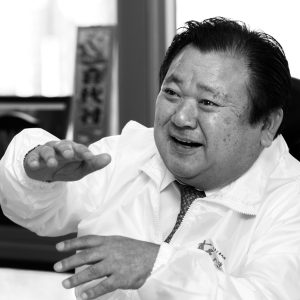
Owner of SUSHIZANMAI Kiyoshi Kimura (70)
<<Popularly known as the Tuna King, Mr. Kimura is famous for his 55 nationwide stores that feature in-store Tuna Cutting Shows. However, behind his infectious smile is a life filled with difficulty and overcoming insurmountable odds. Mr. Kimura lost his father at a very young age. He was unable to proceed with high school studies, he had to give up his dream of becoming a fighter pilot due to an accident during training. He also had to abandon several successful businesses due to the collapse of the Japanese economic bubble. >>
I was three years old when my father passed away. Ever since, the entire family had to work. When I almost gave up entering high school, I joined the Japan Air Self-Defense Force when I was 15 years old, because I heard that one could become a fighter pilot. However, an object fell from a truck onto my head during training. This resulted in my eyes having difficulty focusing, and I had to abandon my dream of becoming a fighter pilot. After working in several part-time jobs and an ordinary office job for a door-to-door sales company, I started working for a fishery company when I was 20 years old. This was offered to me by a job placement agency. To be perfectly honest, I never thought I would keep working in this industry for over 50 years.
I am not quite sure who started calling me the Tuna King. I always check the quality of the tuna by feel and touch, when cutting into it with a knife. I make the final decision after tasting. There were times when I had to butcher 150 or 160 tuna per day, each weighing over 200 kg. Even to this day I travel the world in search of good quality tuna. My guess is that people started calling me the Tuna King because of my uncompromising focus on providing great tasting tuna to my yen for the first time.
*Tuna reaching the highest price at the first auction of the year. This first tuna of the season that is purchased at the first auction of the year is thought to bring good luck and is highly valued by customers.
I might have been a little too focused on this purchase, because I wanted to deliver a festive spirit to everyone in Japan. After all, the memory of the Great Eastern Japan Earthquake still lingered, and I wished for the people all over Japan to taste this Ichiban Maguro. It ended up quite pricey, though.
Fishermen are delighted whenever the first auction receives spotlight. With the ageing workforce, lack of successors and rising fuel prices, the fishermen are facing difficult times, so they could use some good news. As of recently, however, we have kept away from making expensive bids due to the prolonged effect of the COVID-19 eating out and other self-restraint protocols.
customers.
<<During the first auction of the year, in January 2019, I garnered attention for successfully making a bid to purchase a single blue-fin tuna from Oma for 333.6 million yen at 1.2 million yen per kilogram>>
A year after the 2011 Great Eastern Japan Earthquake, I competed against a Hong Kong based sushi franchise during the first auction of the year, where the Ichiban Maguro* exceeded 50 million
<<All tuna will be served at 398 JPY per sushi piece, regardless of the high-priced purchase. This policy stems from my childhood experience>>
When I was a child, every time my mother attended gatherings of relatives or colleagues, rather than eating the food and snacks served at these events, she would always bring them home. One particular day, two pieces of tuna sashimi were among what she brought home. At that time, during the 1950s and the 1960s, tuna was considered an expensive delicacy. My older brother was out of house, just me and my two older sisters were at home. My mother said: “I could have eaten it myself. But if we cut each piece into two, then four people can have a try. It tastes much better to eat together with the family rather than alone. And also, the joy will quadruple!” So we cut the tuna into four pieces and ate it. Now that I think about it, I am pretty sure that sashimi was a pretty inexpensive lean cut of yellowfin or skipjack tuna. But still, it was so delicious. I will never forget the taste of that tiny, half-cut piece of tuna. I named this company Kiyomura, to make sure I will never forget that beautiful memory. That is why I intend not to change the price of an expensive, first-auction tuna, so that more people are able to enjoy it.
(Interviewer: Masatoshi Ono)
Photo by Atari Haruna
Born in 1952, in the town of Sekiyado (present Noda City) in Chiba Prefecture. Graduated from Chuo University, Faculty of Law (Correspondence Course). After completion of middle school, joined the student platoon of the 4th Technical School of Japan Air Self-Defense Force. Retired from service in 1974. Joined a fishery company after working part-time jobs. Branched out on his own in 1979. In 2001, opened SUSHIZANMAI Honten (The Main Store), Japan’s first-ever sushi restaurant open 24 hours a day all year round, in the Tsukiji Outer Market.